


Two Astrological Systems, One Big Question
Have you ever checked your zodiac sign on two different astrology websites and received two different answers?
You are not alone.
One system may tell you that you are a Leo, while another may place you in Cancer. One astrologer may focus heavily on your Sun sign, while another begins with your Moon sign, Ascendant, Nakshatras and planetary periods.
This often leads to one question:
Which astrology is actually more accurate Vedic or Western?
The answer is more nuanced than simply choosing one over the other.
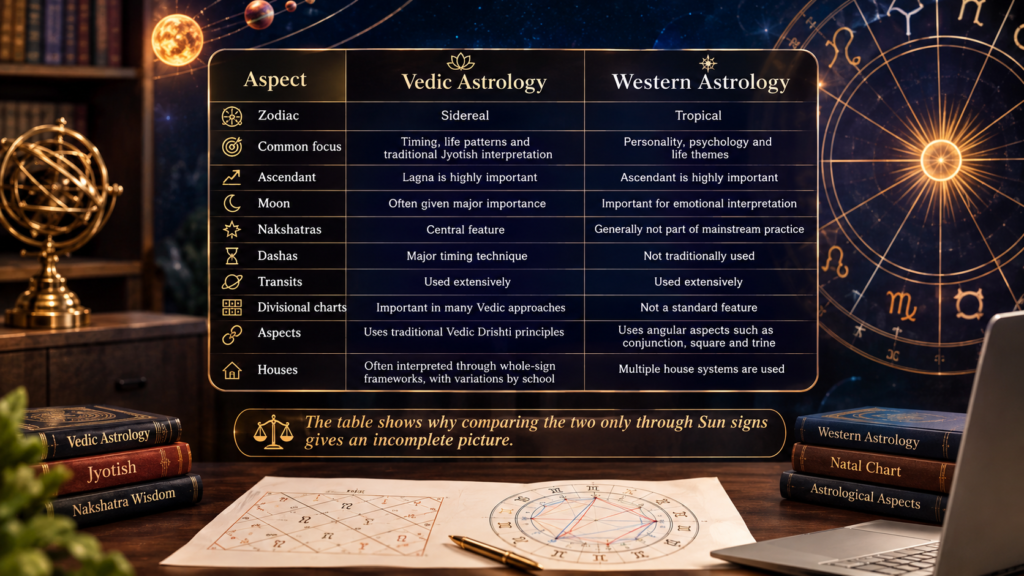
Vedic astrology and Western astrology use different frameworks for interpreting the same sky. They differ in their zodiac reference points, chart calculations, interpretive techniques and approaches to timing.
Best Vedic astrologer , traditionally known as Jyotish, uses a sidereal zodiac, while mainstream Western astrology generally uses a tropical zodiac. Because of the Earth’s axial precession, the two systems are currently separated by roughly 23–24 degrees, depending on the ayanamsa and calculation method used.
That difference can change the zodiac sign in which a planet appears.
But does that automatically make one system more accurate?
Not necessarily.
A better question is:
Which system is more appropriate for the kind of question you want answered?
That is where the real comparison begins.
What Is Vedic Astrology?
Vedic astrology, or Jyotish, is an Indian astrological tradition that analyses the positions of celestial bodies at the time of birth.
A detailed reading can consider several components, including:
- Ascendant or Lagna
- Moon sign or Rashi
- Planetary positions
- Houses
- Nakshatras
- Planetary aspects
- Dashas
- Transits
- Divisional charts
- Yogas
One of the important features of the system is its emphasis on timing.
For example, Vedic astrologers may use planetary periods such as Vimshottari Dasha alongside transits to examine when particular themes may become more prominent.
This makes a Vedic birth-chart reading considerably more detailed than the basic daily horoscope most people encounter online.
For people looking for personalised guidance, the quality of interpretation also matters. A chart is not simply a collection of planetary positions; its meaning depends on how the different elements interact.
Aunkar Vastu, for example, describes its approach as combining birth-chart analysis, planetary positions and personalised recommendations rather than relying only on generic zodiac advice.
What Is Western Astrology?
Western astrology is a broad tradition with many schools and approaches.
Modern Western astrology commonly uses the tropical zodiac, which is linked to the seasonal cycle. In this framework, 0° Aries is associated with the vernal equinox rather than being permanently aligned with the present-day astronomical constellation of Aries.
Western astrology can examine:
- Sun sign
- Moon sign
- Ascendant
- Houses
- Planetary aspects
- Transits
- Progressions
- Retrogrades
- Chart patterns
Many contemporary Western astrologers place considerable emphasis on personality, psychological patterns, emotional behaviour and self-understanding.
However, it is important not to reduce Western astrology to “Sun signs.”
A professional Western natal-chart reading can involve the entire chart and considerably more detail than the familiar horoscope column.
Vedic Astrology vs Western Astrology: The Fundamental Difference
The biggest technical difference is the zodiac reference system.
Vedic Astrology Uses the Sidereal Zodiac
The sidereal approach attempts to maintain a relationship between zodiacal positions and the stellar background.
Because Earth’s rotational axis slowly changes orientation, the equinoxes gradually shift relative to the background stars. This phenomenon is known as precession of the equinoxes.
Vedic astrology accounts for this through an ayanamsa, with different schools using different calculations.
Western Astrology Uses the Tropical Zodiac
The tropical zodiac is anchored to the seasonal cycle.
The beginning of Aries is tied to the vernal equinox, so the zodiac remains seasonally fixed even though the background constellations gradually shift because of precession.
Neither approach is simply a “wrong calculation.”
They are based on different reference frameworks.
That distinction is essential when comparing the two.
Why Does Your Zodiac Sign Change in Vedic and Western Astrology?
This is probably the most common source of confusion.
Suppose your Western birth chart places your Sun at a particular degree of a zodiac sign.
When the same birth data is calculated using a sidereal system, the position may shift backward by approximately 23–24 degrees.
As a result, someone who identifies with one Western Sun sign may have the previous sign as their Vedic Sun sign.
This does not mean that one astrologer made a mistake.
It means the two charts are using different zodiac reference points.
The difference is connected to precession and is commonly described through the term ayanamsa in Vedic astrology.
Example
Imagine a person’s tropical Sun is at 10° Taurus.
Using a sidereal calculation with an ayanamsa of approximately 24°, the Sun would fall around 16° Aries.
So:
Western: Taurus
Vedic: Aries
The person’s birth details have not changed.
The planets have not changed.
The reference system has changed.
What Makes Vedic Astrology Different?
1. The Importance of the Moon Sign
In Vedic astrology, the Moon can have a particularly important role in understanding the mind, emotional tendencies, habits and lived experience.
This is one reason a person’s Vedic reading may seem very different from a simple Western Sun-sign horoscope.
A serious interpretation normally looks at the chart as a whole rather than relying on one placement.
2. Nakshatras Add Another Layer
Vedic astrology divides the zodiac into 27 Nakshatras, or lunar mansions.
Each Nakshatra is further divided into four padas.
This creates a finer interpretive layer than simply assigning someone to one of twelve zodiac signs.
For practitioners who use Nakshatras extensively, this can provide additional context when examining personality patterns and planetary placements.
3. Dashas Introduce a Timing Framework
One of the most distinctive features of Jyotish is the use of planetary periods known as Dashas.
Vimshottari Dasha is one of the best-known systems.
Rather than asking only:
“What does this planet represent?”
the astrologer can also ask:
“When does this planetary influence become especially relevant?”
This timing dimension is one of the reasons people often seek a Vedic consultation for questions involving career changes, relationships, major decisions or different phases of life.
How Western Astrology Approaches Personality and Psychology
Western astrology often places strong emphasis on the psychological interpretation of a natal chart.
For example, an astrologer may examine:
- Sun for identity and self-expression
- Moon for emotional responses
- Mercury for communication
- Venus for relationships and values
- Mars for action and motivation
- Saturn for responsibility and limitations
- Outer planets for broader psychological and generational themes
The relationship between planets is also important.
A square, trine, opposition or conjunction can be interpreted as part of a person’s broader psychological and behavioural pattern.
This makes Western astrology particularly attractive to people interested in self-reflection and personality analysis.
Which One Is More Accurate: Vedic or Western Astrology?
This is where a responsible answer matters.
There is no universally established scientific test showing that one astrological tradition is objectively more accurate than the other for predicting a person’s future.
Therefore, it would be misleading to claim that Vedic astrology is always more accurate or that Western astrology is always more accurate.
Within astrology itself, practitioners judge accuracy according to different criteria.
For example:
- A person may find Vedic timing techniques useful.
- Someone else may find Western psychological interpretations more relatable.
- Another person may appreciate both approaches.
- The astrologer’s training and interpretation may matter as much as the system being used.
The strongest comparison is therefore not:
Vedic = accurate / Western = inaccurate
but:
Vedic and Western astrology answer questions through different frameworks.
When Is Vedic Astrology More Useful?
Vedic astrology may be particularly appealing when someone wants a structured birth-chart analysis involving:
- Life periods
- Planetary Dashas
- Nakshatras
- Marriage compatibility
- Career direction
- Traditional remedies
- Timing of important decisions
- Detailed Kundli interpretation
For example, someone asking:
“What major planetary period am I currently experiencing?”
is asking a question that fits naturally within the Dasha framework.
Likewise, someone interested in traditional Kundli matching may prefer a Vedic approach.
When Is Western Astrology More Useful?
Western astrology may appeal more to someone interested in:
- Personality
- Emotional patterns
- Psychological self-understanding
- Relationship dynamics
- Personal development
- Natal chart symbolism
- Transits and progressions
Someone asking:
“Why do I respond emotionally to situations in this particular way?”
may find a psychologically oriented Western reading especially interesting.
Of course, these are tendencies rather than strict rules. Different astrologers within each tradition use different techniques.
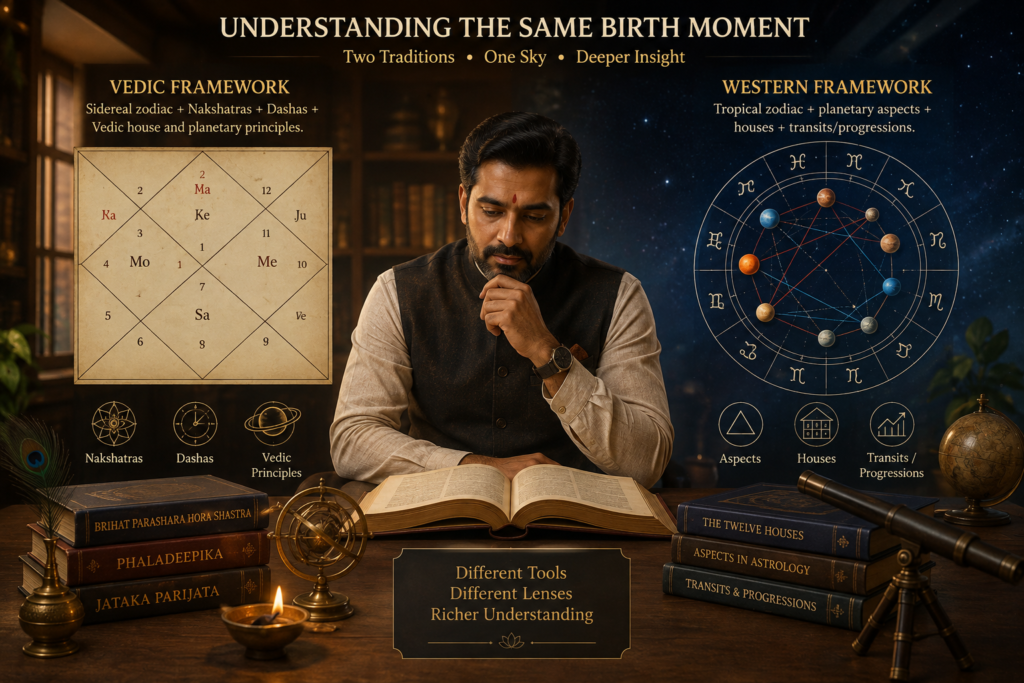
Can Vedic and Western Astrology Be Used Together?
Yes, but they should not be mixed carelessly.
A common mistake is to take a Vedic chart and interpret it using Western rules, or take a Western chart and apply Vedic techniques without understanding the underlying framework.
A better approach is to understand each system on its own terms.
For example:
Why the Astrologer Matters as Much as the System
People sometimes spend too much time asking:
“Which system is the best?”
and not enough time asking:
“Who is interpreting the chart?”
Two astrologers can use the same system and reach different conclusions because interpretation involves experience, methodology and context.
A good consultation should involve:
- Accurate birth details
- A clear explanation of the method
- Personalised interpretation
- Context about the person’s circumstances
- Balanced communication
- No unnecessary fear
- Practical guidance
- Respect for the client’s decisions
Aunkar Vastu states that its astrology services are personalised around individual birth details and life circumstances, with an emphasis on practical guidance.
How to Choose the Right Astrology System for You
Instead of choosing based on which system sounds more impressive, start with your question.
If your question is about timing
You may want to explore Vedic astrology and its planetary-period techniques.
If your question is about personality
A detailed Western natal-chart interpretation may be useful.
If you want traditional Indian astrology
Look for an experienced practitioner trained in Jyotish rather than someone who only provides generic Sun-sign readings.
If you want both
Ask whether the astrologer clearly distinguishes between the two systems rather than blending terminology without explanation.
How to Find a Good Vedic Astrologer
Searching online for the best indian vedic astrologer can produce a long list of results, but ranking alone should not determine your choice.
Look for:
- Experience and training
Understand the practitioner’s background and areas of expertise. - Personalised consultations
A genuine reading should be based on your birth details rather than generic zodiac content. - Clear methodology
The astrologer should be able to explain what techniques are being used. - Practical communication
Guidance should be understandable rather than filled with unexplained terminology. - No fear-based selling
Be cautious of anyone who uses alarming predictions to pressure you into expensive remedies or services. - Respect for personal choice
Astrology should support reflection and decision-making, not replace your judgement.
Aunkar Vastu presents itself as an Australia-based provider of Vedic astrology and Astro Vastu consultations, including services across Melbourne, Sydney, Brisbane and Adelaide.
What About Accuracy in Astrology?
The word “accuracy” needs to be defined before comparing systems.
Accuracy could mean:
- A personality description feels relevant.
- A past event appears to match a chart interpretation.
- A timing technique identifies a meaningful period.
- A consultation provides useful perspective.
- A prediction appears to correspond with a later event.
These are different standards.
From a scientific perspective, astrology should not be presented as a proven method for predicting future events with certainty.
From an astrological perspective, practitioners evaluate charts according to the rules and traditions of their particular school.
That distinction allows readers to explore astrology without making claims that go beyond the available evidence.
A Simple Comparison Using Three Questions
Think of the comparison this way:
Question 1: “Who am I?”
Western astrology can provide an extensive psychological interpretation through the natal chart.
Question 2: “What patterns are visible in my life?”
Both systems can approach this question, but they may use different calculations and interpretive principles.
Question 3: “When might a particular life phase become more prominent?”
Vedic astrology has a particularly structured answer through planetary-period systems such as Dashas.
This does not make one universally superior.
It shows that the systems have different strengths.
Vedic Astrology vs Western Astrology: Which Should You Choose?
There is no need to treat the choice as a competition.
If you are interested in traditional Indian astrology, Kundli analysis, Nakshatras, Dashas and timing techniques, Vedic astrology may be the better starting point.
If you are primarily interested in personality, emotional patterns and psychological interpretation, Western astrology may appeal more strongly.
And if you are curious about both, comparing them can be an interesting way to understand how different traditions interpret the same birth data.
The most important factor is not simply whether an astrologer calls themselves Vedic or Western.
It is whether they understand their chosen system, explain it responsibly and provide an interpretation that is genuinely personalised.
Is Vedic Astrology More Accurate Than Western Astrology?
Not in a way that can be universally established.
Vedic and Western astrology use different zodiac frameworks and interpretive traditions. Vedic astrology uses a sidereal framework and includes distinctive tools such as Nakshatras and Dashas, while Western astrology generally uses the tropical zodiac and has developed extensive psychological and aspect-based approaches.
So instead of asking:
“Which one is more accurate?”
ask:
“Which system is better suited to the question I want to explore?”
That shift makes the comparison much more useful.
If you are looking for personalised Vedic guidance, choosing an experienced practitioner who explains the methodology, considers your complete chart and avoids generic predictions is more important than simply choosing someone because they appear high in search results.
For readers exploring personalised Vedic astrology and Astro Vastu services in Australia, Aunkar Vastu offers consultations based on individual birth details and astrological analysis.
Frequently Asked Questions
1. How is Vedic astrology different from Western astrology?
Vedic astrology generally uses a sidereal zodiac, while Western astrology generally uses a tropical zodiac. Vedic astrology also incorporates techniques such as Nakshatras, Dashas and divisional charts that are not standard features of mainstream Western astrology. Western astrology often places greater emphasis on psychological interpretation, planetary aspects and transits.
The difference does not mean that one system is automatically correct and the other is incorrect. They begin with different reference frameworks and have developed different interpretive traditions.
2. Why is my Vedic zodiac sign different from my Western zodiac sign?
Your sign may change because the two systems use different zodiac reference points.
Western astrology generally uses the tropical zodiac, which is tied to the seasonal equinoxes. Vedic astrology generally uses a sidereal zodiac that accounts for the gradual shift between the seasonal reference point and the stellar background.
The resulting difference is commonly around 23–24 degrees today, depending on the ayanamsa used.
So if your Western Sun is near the beginning of a sign, your Vedic Sun may fall in the previous sign.
3. When should I choose a Vedic astrologer instead of a Western astrologer?
Consider your purpose.
If you are interested in traditional Jyotish, Kundli interpretation, Nakshatras, Dashas, marriage matching or timing-oriented analysis, a practitioner trained in Vedic astrology may be more appropriate.
If your primary interest is psychological self-understanding, personality patterns and modern Western natal-chart interpretation, a Western astrologer may be a better fit.
The best choice ultimately depends on what you want to understand.
4. Why do people consider Vedic astrology highly detailed?
One reason is the number of layers that can be incorporated into a Vedic reading.
Depending on the practitioner’s school, an analysis may consider the Ascendant, Moon sign, planetary placements, houses, Nakshatras, Dashas, transits, yogas and divisional charts.
This creates a more detailed interpretive framework than a basic Sun-sign horoscope.
However, greater detail does not automatically mean greater predictive certainty. The quality of interpretation and the limits of astrological claims should still be considered.
5. How do I find the best Indian Vedic astrologer for a personal consultation?
Rather than choosing an astrologer solely because a website uses the phrase “best Indian Vedic astrologer,” evaluate the actual quality of the service.
Check:
- The astrologer’s experience and background
- Whether consultations are personalised
- Whether the methodology is explained
- Whether birth details are properly considered
- Reviews and testimonials where available
- Whether recommendations are practical
- Whether the consultation avoids fear-based claims
- Whether the astrologer respects your ability to make your own decisions
A good consultation should leave you with greater understanding and clarity, not unnecessary fear.
For people in Australia exploring Vedic astrology, Aunkar Vastu offers personalised astrology services and describes its approach as combining traditional astrology with practical guidance.