
>
loading

Category: Vastu Shastra

  • Home
  • Category: Vastu Shastra

5 Zone Vastu for Business: How the Five Zones Can Shape a Better Commercial Space

A commercial property is more than four walls, furniture and a business sign. The way an office, shop, studio, clinic or commercial unit is planned can influence how people move through the space, how teams use it and how different activities are organised.

This is where Vastu Shastra for Business becomes relevant for business owners who want to consider traditional spatial principles while planning or reviewing a commercial property.

One practical way to begin is by understanding the five major directional zones North, South, East, West and the central area of the property. Rather than treating every direction as a rigid rule, these zones can be considered alongside the purpose of the space, entrances, movement patterns, work areas and the existing structure.

In this guide, we explain how the five-zone approach can be used for commercial properties, when it makes sense to consider it, why each zone matters traditionally, and how business owners can approach the planning process without unnecessary structural changes.
What Is the Five-Zone Approach in Vastu?

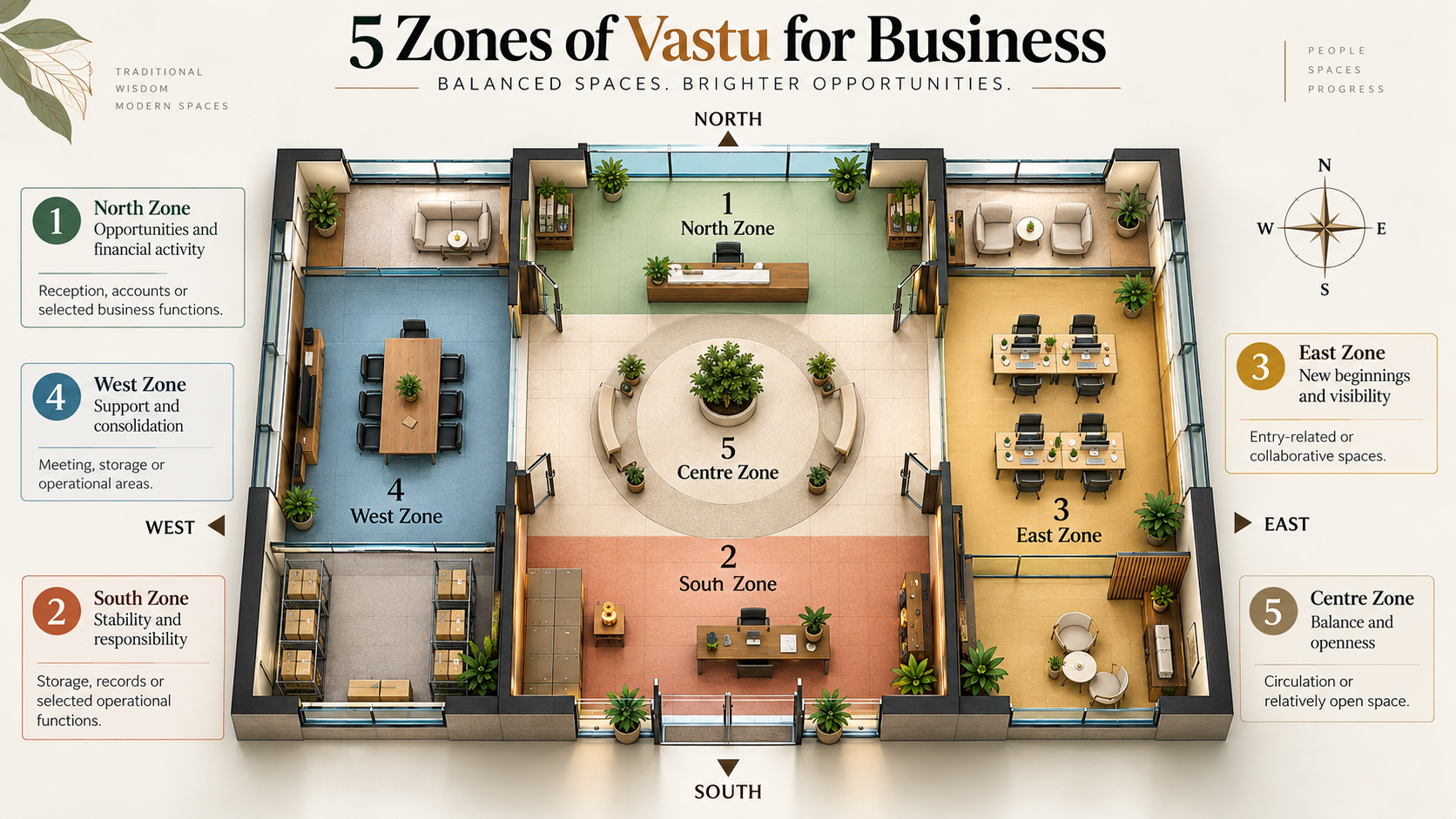
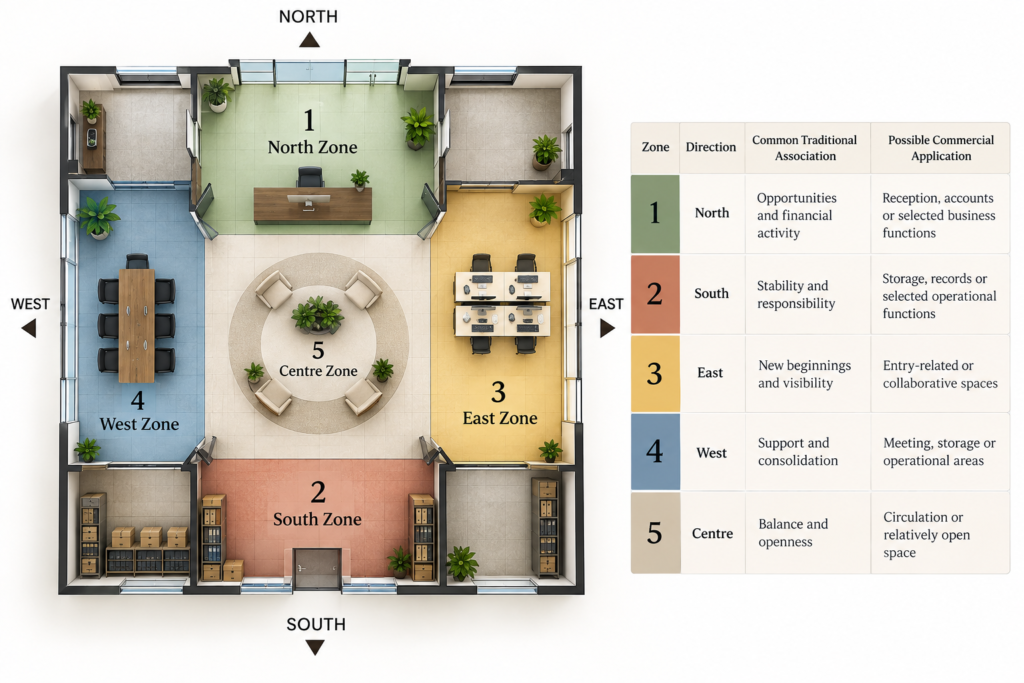
The five-zone approach divides a commercial property into five broad areas based on direction and central space:

The exact application should depend on the shape, orientation, entrances, floor level and purpose of the property.

This is important because a factory, retail showroom and corporate office do not use space in the same way.

A useful commercial assessment therefore looks at the property as a whole rather than applying one rule repeatedly.

Why Consider Vastu When Planning a Commercial Property?

Business owners generally think about location, rent, accessibility, parking, visibility, infrastructure and customer convenience before selecting a property.

Spatial planning can be another layer of consideration.

The reason is simple: commercial spaces have different functional requirements.

The 5 Zones of Vastu for Business Explained

1. North Zone — Traditionally Associated With Opportunities

The northern portion of a property is traditionally given importance in many Vastu approaches.

For businesses, this area may be considered while planning functions associated with financial administration, communication or business activity.

For example, depending on the property layout, a business may evaluate whether certain administrative functions can comfortably operate in this part of the premises.

What to Consider

When evaluating the northern zone, look at:

  • Whether the area is unnecessarily blocked
  • Natural light and ventilation
  • Ease of movement
  • Placement of heavy permanent structures
  • Accessibility of important work areas
  • Overall cleanliness and usability

The objective should not be to move everything simply because a direction is considered favourable.

Instead, assess whether the existing layout creates practical problems.

When Should You Pay Attention to the North Zone?

It can be particularly useful to review this zone when:

  • Selecting a new commercial property
  • Designing a new office
  • Renovating an existing workspace
  • Relocating a business
  • Reviewing an underperforming layout

2. South Zone — Stability, Structure and Responsibility

The southern part of a commercial property is often discussed in traditional Vastu as an area associated with stability and strength.

From a practical planning perspective, this can be an interesting zone for functions that require relatively fixed positioning.

Depending on the property and business type, examples could include:

  • Storage
  • Records
  • Equipment
  • Certain operational areas
  • Fixed furniture

However, this does not mean that every business should automatically place heavy objects in the South.

The property should first be assessed according to its actual orientation and structural design.

A Common Mistake

One common mistake is treating a directional rule as an isolated instruction.

For example:

“South means heavy.”

That is an oversimplification.

The real question should be:

How does the southern section interact with the rest of the property?

This is why professional assessment can be useful for unusual floor plans, irregular plots or existing commercial buildings.

3. East Zone — Traditionally Linked With Light and New Activity

The East has an important place in traditional Vastu principles and is commonly associated with sunrise, light and new beginnings.

For a commercial property, the eastern area can therefore be evaluated for functions that benefit from openness, accessibility or natural light.

Possible considerations include:

  • Reception
  • Entry-related areas
  • Collaborative workspaces
  • Waiting areas
  • Open circulation

Again, these are planning considerations rather than universal rules.

A business should never compromise basic requirements such as fire safety, accessibility, ventilation or employee comfort simply to follow a directional preference.

How Can the East Be Used Better?

Start by asking:

  1. Is the area unnecessarily blocked?
  2. Does natural light reach the space?
  3. Is movement comfortable?
  4. Does the entrance work well for visitors?
  5. Is furniture creating unnecessary congestion?

These questions make the traditional concept much more practical.

4. West Zone — Support and Consolidation

The western part of a commercial property can also be considered during space planning.

Rather than looking at the West in isolation, evaluate its relationship with the other zones.

Depending on the business, the area may accommodate functions such as:

  • Meeting areas
  • Storage
  • Operational activities
  • Supporting departments
  • Selected workspaces

The ideal arrangement will differ according to the business model.

For instance, a design studio may require an entirely different layout from an accounting office.

Why Business Type Matters

Imagine two properties with exactly the same dimensions.

One is a retail showroom.

The other is a manufacturing office.

Their spatial requirements are completely different.

That is why commercial Vastu shastra for business should be approached through both direction and function, rather than through a one-size-fits-all checklist.

5. The Centre Zone — The Space That Connects Everything

The centre of a property is especially important in traditional Vastu planning.

It is often associated with balance and should generally be considered carefully when planning circulation and large permanent structures.

In a commercial environment, the centre can become crowded very quickly because businesses often try to fit:

  • Tables
  • Cabinets
  • Display units
  • Storage
  • Equipment
  • Partitions
  • Decorative elements

The result can be a space that technically fits everything but feels uncomfortable to move through.

A Better Approach

Keep the central circulation area as practical and uncluttered as the property allows.

This can improve:

  • Movement
  • Visibility
  • Accessibility
  • Spatial perception
  • Employee comfort
  • Visitor experience

The traditional Vastu perspective and practical workplace planning can therefore sometimes point toward the same basic principle: avoid unnecessary obstruction in important circulation areas.

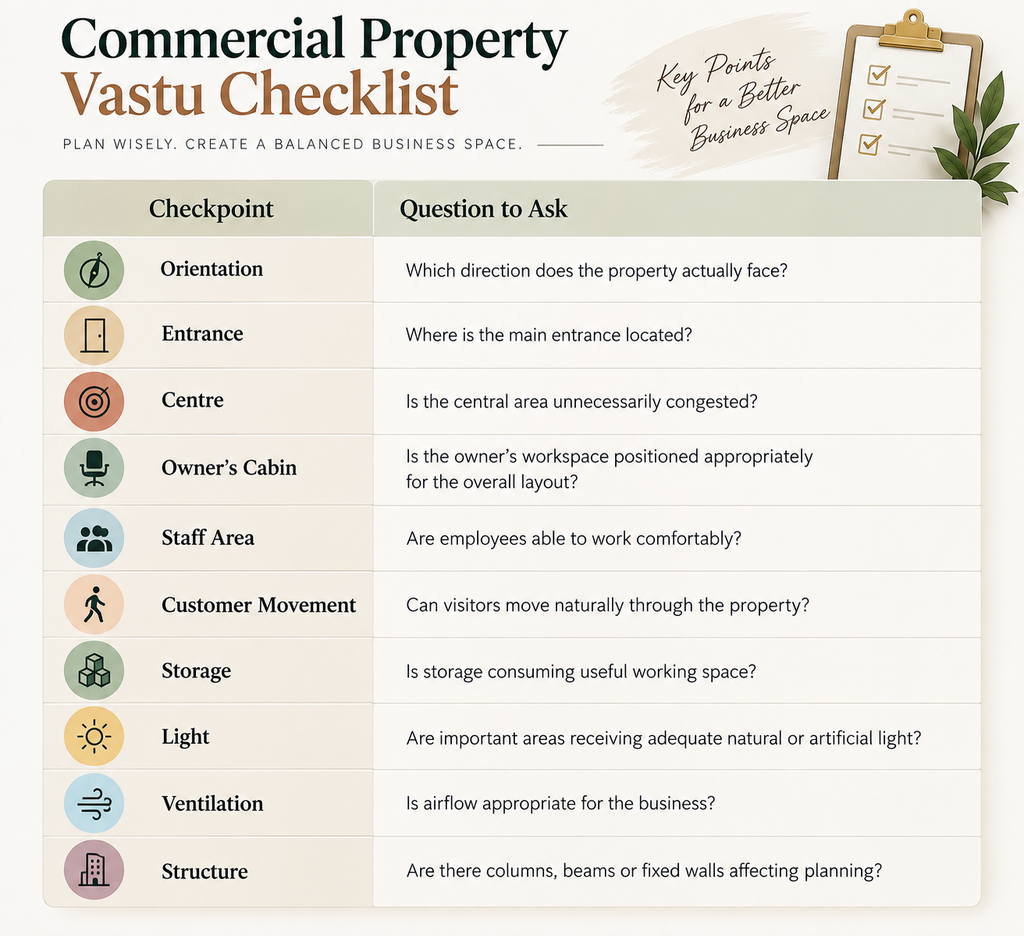
5-Zone Vastu Business Planning Checklist

Before making changes to a commercial property, consider the following:
How to Apply 5 Zone Vastu to Different Businesses

The same five zones cannot be applied identically to every commercial property.

Office

For an office, examine:

  • Owner/leadership seating
  • Employee workstations
  • Reception
  • Meeting rooms
  • Records
  • Pantry
  • Circulation

Retail Shop

A retail space needs additional attention to:

  • Customer entry
  • Product displays
  • Billing counter
  • Customer movement
  • Storage
  • Exit

Clinic

A clinic may need to evaluate:

  • Reception
  • Waiting room
  • Consultation rooms
  • Treatment areas
  • Records
  • Staff areas

Restaurant

The planning process can involve:

  • Entrance
  • Dining area
  • Kitchen
  • Storage
  • Billing
  • Service movement

Factory or Industrial Unit

Industrial properties require a much more detailed assessment because of:

  • Machinery
  • Raw materials
  • Production lines
  • Loading areas
  • Finished goods
  • Worker movement
  • Safety requirements

This is why a factory should not simply copy the layout recommendations intended for a small office.

What Should You Check Before Buying or Renting a Commercial Property?

If you are considering a new property, it is easier to assess spatial considerations before signing a long-term lease or purchasing the premises.

Here is a practical checklist.

1. Confirm the Orientation

Do not assume the direction from the road or neighbouring building.

Use an accurate method to establish the property’s orientation.

2. Examine the Entrance

Study:

  • Direction
  • Position
  • Width
  • Accessibility
  • Visitor movement

3. Study the Shape

Regular and irregular plots can create very different planning challenges.

4. Check the Centre

Look for:

  • Large permanent structures
  • Heavy storage
  • Unnecessary partitions
  • Equipment
  • Congested circulation

5. Understand the Business Function

Ask what the property actually needs to accommodate.

A good commercial layout starts with the business not just the compass.

Can Vastu Be Considered Without Demolishing the Property?

Yes, many business owners specifically look for ways to review an existing property without undertaking major structural work.

Depending on the situation, the assessment may focus on:

  • Furniture placement
  • Workstation arrangement
  • Storage positioning
  • Space utilisation
  • Entrance experience
  • Colour and material choices
  • Decluttering
  • Functional zoning

The suitability of any remedy depends on the actual property.
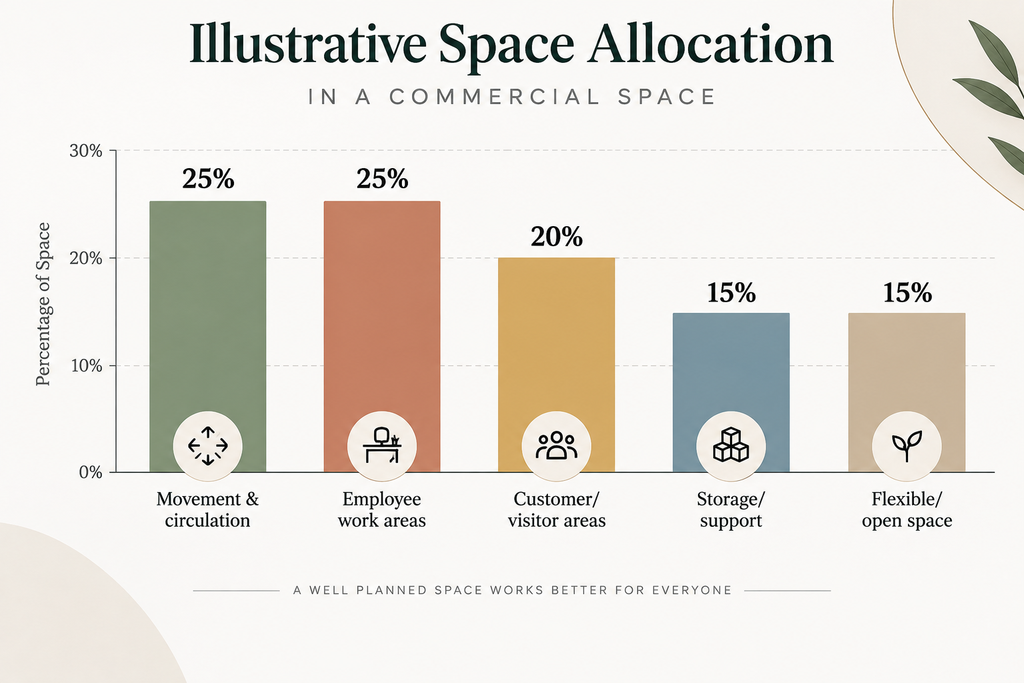
How Aunkar Vastu Can Help With Commercial Space Planning

For business owners who want to evaluate a property through traditional Vastu principles, the first step should be understanding the property rather than immediately changing it.

A professional assessment can consider:

  • Property orientation
  • Floor plan
  • Entrances
  • Functional zones
  • Owner’s workspace
  • Employee seating
  • Customer movement
  • Storage
  • Existing structural limitations
  • Business requirements

For an existing commercial property, the assessment can also distinguish between changes that are practically possible and changes that would require structural work.

This makes the process more relevant for businesses operating from rented offices, established shops or already-built commercial spaces.

Frequently Asked Questions

1. What is 5 Zone Vastu for business?

Five-zone Vastu is a simplified way of examining a commercial property through its North, South, East, West and central areas. Each zone has traditional associations, and these can be considered alongside the actual functions of the business.

It should not be treated as a guaranteed method for increasing revenue or ensuring business success. The purpose is to provide a traditional spatial-planning perspective that can be considered with practical design requirements.

2. How can Vastu be applied to an existing commercial property?

Vastu considerations can be reviewed after examining the property’s orientation, floor plan, entrances, furniture, work areas, storage and circulation.

In an existing property, the focus may be on practical adjustments such as furniture positioning, workstation planning, decluttering and functional zoning rather than immediately changing the building structure.

However, the appropriate approach depends on the individual property.

3. When should a business owner consult a Vastu expert?

A consultation may be considered before buying or renting a commercial property, while designing a new office, during renovation, before relocating a business or when reviewing an existing layout.

Getting the property assessed earlier can make planning easier because there may be more flexibility before furniture, partitions and equipment are permanently installed.


25 Vastu Shastra Rules Every Homeowner Should Follow for a Balanced and Prosperous Home

Creating a home is about more than choosing the perfect design or location. The way a home is planned, organised, and maintained can influence comfort, productivity, and overall well-being. This is where Vastu Shastra for House comes into the picture.

Based on ancient Indian architectural principles, Vastu Shastra focuses on creating harmony between nature and the built environment. While modern homes have evolved in design, many homeowners still rely on these time-tested principles to create spaces that feel peaceful and balanced.

Whether you’re planning a new home, renovating an existing one, or simply looking to improve the energy within your living space, these practical guidelines can help. Consulting an experienced Vastu Consultant for Home can also provide personalised recommendations based on your property’s layout and your family’s needs.

Why Vastu Shastra Still Matters Today

Modern architecture prioritises aesthetics and functionality, but Vastu Shastra adds another dimension by encouraging balance between natural elements, sunlight, airflow, and spatial planning.

Many homeowners choose Residential Vastu to:

  • Create a positive living environment
  • Improve natural light and ventilation
  • Support peaceful family relationships
  • Make better use of available space
  • Enhance overall comfort and well-being

Rather than replacing architectural design, Vastu complements it with practical planning principles.

25 Vastu Shastra Rules Every Homeowner Should Follow

1. Choose the Right Plot Orientation

North and east-facing plots are often preferred due to better sunlight exposure and natural energy flow.

2. Keep the Main Entrance Clean and Bright

The entrance creates the first impression of any home. Ensure it remains uncluttered, well-lit, and welcoming.

3. Place the Kitchen in the South-East

Traditionally, the south-east direction is associated with the fire element, making it suitable for cooking areas.

4. Position the Master Bedroom in the South-West

This location is believed to offer stability and better rest for homeowners.

5. Avoid Mirrors Facing the Bed

Mirrors reflecting the bed may create unnecessary visual distractions while sleeping.

6. Ensure Proper Ventilation

Fresh air and natural light improve both comfort and indoor environmental quality.

7. Keep the Centre of the Home Open

The central portion should remain as open and clutter-free as possible.

8. Design a Well-Lit Living Room

A bright living room creates a welcoming atmosphere for guests and family.

9. Maintain Clean Water Areas

Bathrooms and water storage should remain clean and leak-free.

10. Use Light Colours

Neutral and earthy tones often create a calming environment.

11. Keep Heavy Furniture in Stable Zones

Position heavier furniture against solid walls whenever possible.

12. Organise Storage Areas

Avoid accumulating unnecessary clutter.

13. Create a Dedicated Prayer or Meditation Space

A quiet corner encourages relaxation and mindfulness.

14. Maximise Natural Sunlight

Morning sunlight naturally brightens indoor spaces.

15. Use Indoor Plants Wisely

Healthy plants improve aesthetics while creating a refreshing atmosphere.

16. Keep Electrical Equipment Organised

Avoid tangled wires and poorly placed appliances.

17. Ensure Proper Drainage

Good drainage helps maintain hygiene and structural health.

18. Avoid Sharp Corners Facing Seating Areas

Rounded layouts often create a softer visual experience.

19. Keep the Dining Area Comfortable

Shared meals strengthen family connections.

20. Maintain a Balanced Colour Palette

Use colours consistently throughout the home.

21. Avoid Structural Imbalance

Well-balanced layouts improve movement and functionality.

22. Prioritise Natural Airflow

Cross ventilation contributes to healthier indoor environments.

23. Use Quality Construction Materials

Strong construction supports long-term durability.

24. Regularly Inspect the Property

Address maintenance issues before they become costly repairs.

25. Seek Professional Guidance

Every property is unique. Working with a qualified Vastu Consultant for Home ensures recommendations are tailored to your home’s design rather than relying on generic advice.


When Should You Consult a Vastu Expert?

Professional guidance can be valuable during several stages of homeownership:

  • Before purchasing land
  • While designing floor plans
  • During renovations
  • Before moving into a new home
  • When planning room modifications

An experienced consultant evaluates your property’s layout and provides practical recommendations that work alongside modern architectural requirements.

How Residential Vastu Benefits Your Home


While every family’s experience is different, many homeowners appreciate Residential Vastu because it encourages thoughtful planning.

Potential benefits include:

AspectPossible Benefit
LayoutBetter space utilisation
VentilationImproved airflow
SunlightBrighter interiors
OrganisationReduced clutter
ComfortMore balanced living environment


A thoughtfully designed home supports both functionality and comfort. By following these 25 Vastu Shastra rules, homeowners can make informed decisions about layout, organisation, and everyday living. Whether you’re building a new property, renovating an existing one, or seeking guidance for a modern residence, applying the principles of Vastu Shastra for House can complement good architectural design.

For personalised recommendations based on your home’s orientation and layout, consider consulting Aunkar Vastu. Their tailored approach helps homeowners implement practical Vastu solutions that align with modern lifestyles while respecting traditional principles.

Frequently Asked Questions

1. What is Vastu Shastra for House?

Vastu Shastra is a traditional system of architectural planning that focuses on creating harmony between a building, its occupants, and the surrounding environment. It considers factors such as orientation, room placement, natural light, ventilation, and spatial balance to support comfortable living.

2. Why should I consult a Vastu Consultant for Home?

A professional consultant can assess your home’s layout and provide recommendations tailored to your property. This personalised approach is often more practical than relying solely on general guidelines, especially for modern apartments and custom-designed homes.

3. Can Residential Vastu be applied to apartments?

Yes. Many Vastu principles can be adapted for apartments by focusing on room arrangement, furniture placement, natural lighting, ventilation, and maintaining organised, clutter-free spaces.

4. When is the best time to consider Vastu?

The ideal time is before purchasing land or finalising architectural plans. However, Vastu recommendations can also be incorporated during renovations or after moving into an existing home through practical, non-structural adjustments where appropriate.

5. Does following Vastu require major renovations?

Not necessarily. Many improvements involve better space organisation, enhancing natural light, optimising furniture placement, and maintaining a clean, well-ventilated environment. A qualified consultant can recommend solutions that fit your home’s existing design.

10 common Vastu Myths you need to Understand  

The literal meaning of Vastu Shastra is “the science of architecture.” The goal of this age-old Indian science is to create a joyful and positive living environment by mixing the concepts of design, layout, and measures with the natural world. While many of the vastu ideas that are currently popular are simply myths that won’t benefit you, Vastu shastra for house can still be used to help you create a peaceful household. Like any other ancient method, Vastu Shastra is covered in myths and false beliefs.


Here are 10 common Vastu Myths you need to understand 


Myth #1: Vastu is a spiritual practice

A lot of people think that Vastu Shastra is a kind of religion. Vastu Shastra is a science. However, Vastu Shastra is a science and is not connected to any one belief. It can be used in any construction, regardless of the residents’ faith, and is founded on scientific principles.


Myth #2: It is impossible to modify a building’s Vastu

The idea that a building’s Vastu cannot be altered once it is constructed is another widespread misconception regarding Vastu Shastra. On the other hand, Vastu Shastra offers fixes and ways to address the shortcomings in a building’s layout and architecture. It is simple to apply these solutions to enhance a building’s Vastu. For instance, a Vastu Shastra consultant can recommend constructing a new door or reorienting the existing one if a house’s entrance is facing the incorrect way.


Myth #3: Bedrooms are not allowed to have mirrors.

Mirrors are not supposed to be in bedrooms, according to Vastu Shastra for house, since they draw bad energy. This is only partly accurate, though. If they are not facing the bed, mirrors might be positioned in the bedroom. Mirrors can increase natural light and create the illusion of a larger space. It is imperative to refrain from placing mirrors in such a way that they reflect the bed since this may generate an uncomfortable aura within the area.


Myth #4: Looking east is generally a good idea when working or studying

When working or studying, turning your head to the east can help you focus and be more productive. But this isn’t totally accurate. Although there are advantages to looking east, it’s not required to do so constantly. The most important thing is to create a workspace that is tidy and pleasant. A comfy chair, sufficient ventilation, and good lighting are important.


Myth #5: Homes that face south are unlucky

South-facing homes are said to be unlucky since they do not benefit from the sun’s rays, according to Vastu Shastra for house. This is also not totally accurate. If the house is properly designed and laid out, homes facing south can be just as fortunate as homes facing any other direction. For example, to increase light and create an air of openness, a house facing south can be constructed with huge windows on the north side.


Myth No. 6: All issues may be resolved by Vastu Shastra

Although it helps enhance a building’s energy flow, Vastu Shastra is not the cure. It’s critical to keep in mind that a person’s entire well-being is influenced by a variety of things, including relationships, events, and personal decisions, in addition to the principles of Vastu Shastra. Vastu Shastra is not a magic bullet for all issues, but it can offer direction and remedies to enhance a building’s energy flow.


Myth #7: Hanging a mirror above your front door can bring good fortune

According to the vastu shastra for home, a mirror at the front door of a house is said to bring good fortune to many. A mirror won’t get good fortune, but it can increase natural light and give the impression that the entry is larger. Positive energy and hard labour are the sources of good luck. Additionally, it’s critical to avoid positioning mirrors in areas that may reflect bad energy, such as a dark or congested room.


Myth #8: Vastu is only applicable to homes

Although it is commonly used to construct homes,other than Vastu Shastra for home it can also be applied to other types of structures, including factories, shops, and offices. Vastu Shastra can actually be used for other places such as vastu for commercial building, vastu shastra for business. Vastu Shastra’s tenets can be applied to establish a cheerful and balanced atmosphere that fosters well-being, creativity, and productivity.


Myth #9: Hanging images of gods can be fortunate

Many individuals think it’s lucky to have artwork of deities in their offices or houses. Once more, this is not the universal reality. Although the use of religious icons or symbols can instil comfort and happiness in an area, it’s important to refrain from packing the room with an excessive number of paintings or statues. Furthermore, it is crucial to make sure the images are not facing the bed or any other source of bad energy and are hanging in the proper orientation.


Myth No. 10: Only Indians can utilise Vastu Shastra

The idea that Vastu Shastra is exclusively for Hindus or Indians is another widespread misconception regarding it. Nonetheless, because Vastu Shastra is founded on natural and scientific principles, it can be adapted to any culture or faith. Actually, by applying the concepts of Vastu Shastra for home, vastu for commercial building or vastu shastra for business, people from a wide range of cultures and religious traditions have successfully enhanced energy flow and balance in their homes and workplaces. A global tool, Vastu Shastra can be used by anybody seeking to build a harmonious and happy atmosphere.You can connect with Acharya Oum Prakash sharma a renowned vastu shastra expert for vastu shastra in australia. 


In summary

A scientific method called Vastu Shastra can be utilised to plan and construct buildings that blend in with the environment. But it’s important to distinguish reality from fiction and reject the myths and false information that surround this activity. One may design and construct buildings that are suitable for housing, employment, and prosperity by knowing the true principles of Vastu Shastra for home, vastu for commercial building, vastu shastra for business

It’s also critical to understand that, although offering direction and remedies to enhance a building’s energy flow, Vastu Shastra cannot replace common sense and pragmatism. For instance, although Vastu Shastra may recommend a specific orientation for a home’s entry, it’s advisable to take accessibility, ease of usage, and safety into account as well.

In the end, Vastu Shastra is a tool that any structure can employ to create a good and harmonious atmosphere. We may design and construct buildings that are in harmony with the natural world and beneficial to our well-being by knowing the fundamental principles of Vastu Shastra and busting myths and misconceptions about it.

Harnessing Positive Energy: Vastu Tips for a Harmonious Home

A harmonious and positive living space is more crucial than ever in our fast-paced lives. Vastu, an ancient Indian architectural practice, offers valuable insights into channeling positive energy within your home. Let’s delve into the basics of residential Vastu with the guidance of a Vastu consultant for house and discover practical tips for fostering positive vibes in every corner of your living space.

Understanding Residential Vastu Basics:

Residential Vastu is more than just arranging furniture; it creates a balanced and energy-filled environment’s is based on the five elements: earth, water, fire, air, and space. These components affect the movement of energy in your home.. Recognizing these principles is the first step towards cultivating positive vibes, especially with the expertise of a Vastu consultant.

Vastu Tips for Entrance and Living Areas:

  1. Main Entrance Importance:
    1. The main entrance is considered the gateway for energy. Ensure it’s well-lit, clutter-free, and inviting to allow positive energy to enter your home with the guidance of a Vastu consultant for house.
  2. Living Room Vibes:
    1. Arrange furniture to encourage easy conversation and maintain a clutter-free living space with the expertise of a residential Vastu consultant. Incorporate natural elements like plants for added positivity.
  3. Declutter for Energy Flow:
    1. Remove unnecessary items to allow energy to flow freely. A clutter-free space, guided by a residential Vastu consultant, promotes a sense of calmness and positivity.

Harmonizing Bedrooms with Vastu:

  1. Optimal Bedroom Layout:
    1. Arrange the bed according to the vastu shastra for homes and make sure it’s conveniently accessible from all directions.This promotes a sense of security and tranquility.
  2. Bed Placement and Direction:
    1. Avoid placing the bed under a window or directly facing the bedroom door. Optimal bed placement enhances restful sleep and positive energy.
  3. Colors and Decor for Serenity:
    1. Choose soothing colors and decor elements that create a peaceful and calming atmosphere in the bedroom, as Vastu shastra for home suggests.

Balancing Energy in the Kitchen:

  1. Vastu Guidelines for Kitchen:
    1. Ensure the kitchen is well-ventilated and well-lit, following Vastu shastra for home guidelines and with the assistance of a Vastu consultant for house. The placement of cooking appliances should enhance positive energy.
  2. Natural Elements in the Kitchen:
    1. Incorporate natural elements like plants or herbs in the kitchen,  to maintain balance and positive energy.

Vastu Tips for Home Office and Workspaces:

  1. Productive Work Environment:
    1. Arrange the home office to promote productivity and positivity. Ensure the desk is positioned for maximum focus and creativity.
  2. Ideal Desk Placement:
    1. Place the desk so that you face the door while working, following the advice of a residential Vastu consultant. This fosters a sense of control and positive energy.
  3. Colors and Elements:
    1. Choose colors and decor elements that inspire creativity and focus, with recommendations from a residential Vastu consultant, creating a positive work environment.

Enhancing Positive Energy with Colors:

  1. Impact of Colors on Mood:
    1. Explore how different colors influence energy and mood in each room, considering suggestions from a vastu shastra consultant
  2. Vastu-Approved Color Schemes:
    1. Learn about Vastu-approved color schemes for various rooms, ensuring positive energy flows.

Vastu Remedies for Common Issues:

  1. Addressing Residential Vastu Challenges:
    1. Practical remedies for common residential Vastu challenges, such as blocked energy flow or negative energy pockets,
  1. Tips for a Harmonious Living Space:
    1. Additional tips for dealing with negative energy and creating an overall harmonious living space, drawing on the expertise of a residential Vastu consultant.

Outdoor Spaces and Residential Vastu:

  1. Extending Vastu Principles Outdoors:
    1. Applying residential Vastu principles to outdoor areas for a well-rounded, positive environment 
  2. Landscaping and Garden Design:
    1. Tips for landscaping and garden design that align with residential Vastu principles, 

Conclusion:

In conclusion, implementing residential Vastu principles is about making small yet impactful changes in your living space. Following these tips, you can create a home that resonates with positive energy, fostering well-being and harmony. Remember, the subtle adjustments, combined, can lead to a more positive and energized living environment. Embrace the journey to a harmonious home filled with positivity.

Open chat
Welcome to Aunkar Vastu
Hello 👋
Can we help you?