
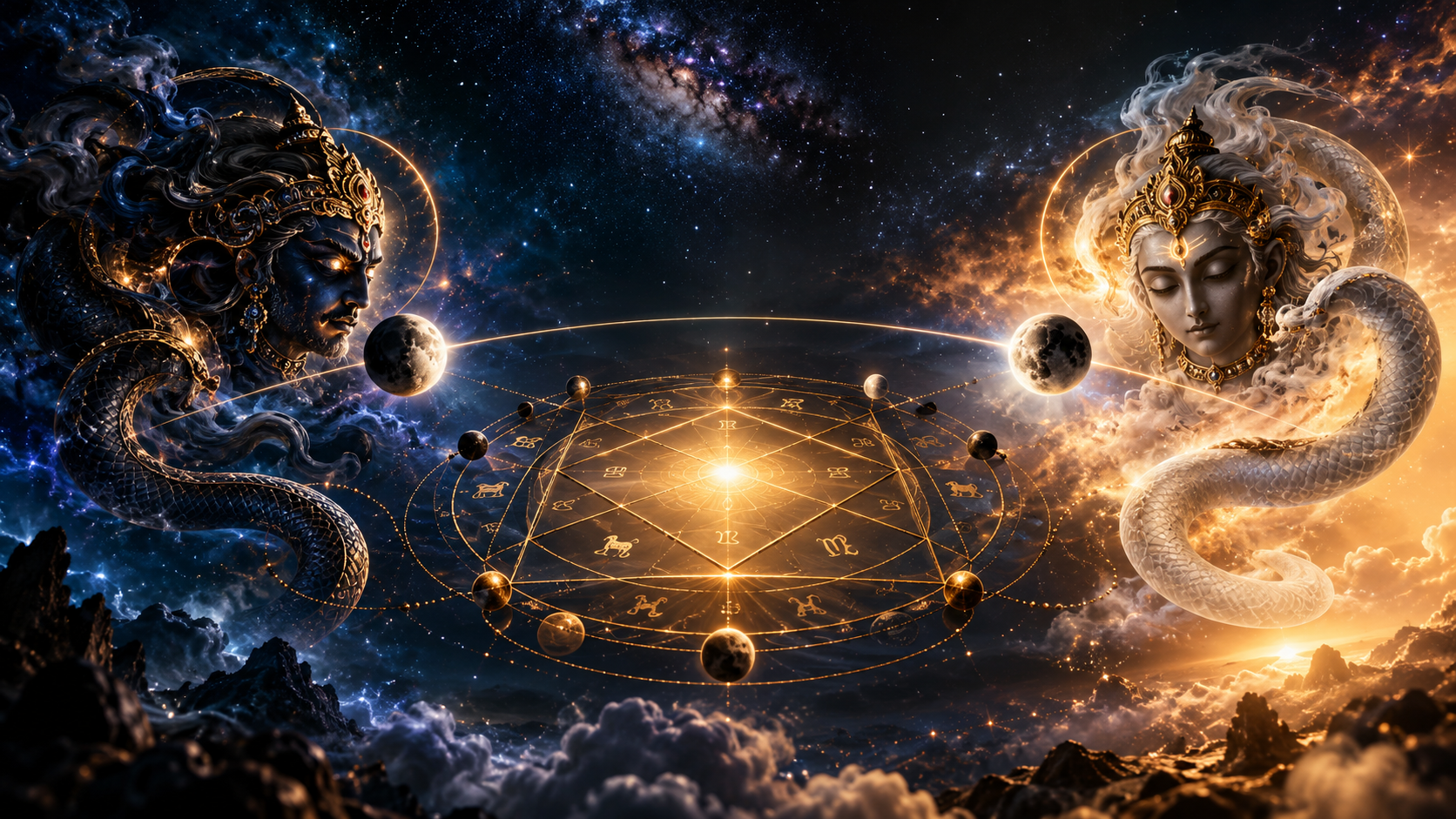
In Vedic astrology, some planetary influences are easy to understand because they are associated with visible planets such as Jupiter, Saturn, Venus or Mars. Rahu and Ketu are different. They are not physical planets, yet they hold an important place in Jyotish because they represent the two lunar nodes and are traditionally associated with the areas of life where a person may experience strong desires, detachment, uncertainty, transformation and inner growth.
For someone exploring Vedic astrology in Sydney, understanding Rahu and Ketu can provide useful context when studying a birth chart. Their interpretation is not based simply on whether they are “good” or “bad.” Their meaning depends on factors such as their house placement, zodiac sign, planetary associations, aspects, nakshatra and the broader condition of the birth chart.
This is one reason a personalised birth-chart analysis can be more meaningful than a generic horoscope.
At Aunkar Vastu, Vedic astrology consultations are designed around individual birth details rather than one-size-fits-all predictions. The practice currently offers astrology-related guidance across Australia, including Sydney.
What Are Rahu and Ketu in Vedic Astrology?
Rahu and Ketu are traditionally described as the north and south lunar nodes.
They are calculated points created by the intersection of the Moon’s orbital path with the apparent path of the Sun. Unlike physical planets, they do not have a physical body in the sky in the same way as Mars or Jupiter.
In Jyotish, however, they are treated as significant influences.
Why Are Rahu and Ketu Important in a Birth Chart?
A birth chart is made up of multiple planetary positions, houses, signs and relationships. Rahu and Ketu form an axis across two opposite houses.
This can highlight an important contrast in a person’s life.
One side may represent areas where a person feels intense curiosity, ambition or a desire to experience something new. The opposite side may represent areas where the person feels naturally detached, familiar or less motivated by conventional rewards.
This is why astrologers often study the Rahu–Ketu axis when interpreting patterns of:
- ambition
- relationships
- career choices
- personal identity
- emotional attachments
- spiritual interests
- sudden changes
- unconventional experiences
- personal growth
The interpretation becomes more meaningful when these placements are considered alongside the rest of the chart.
Rahu: The Energy of Desire, Ambition and Exploration
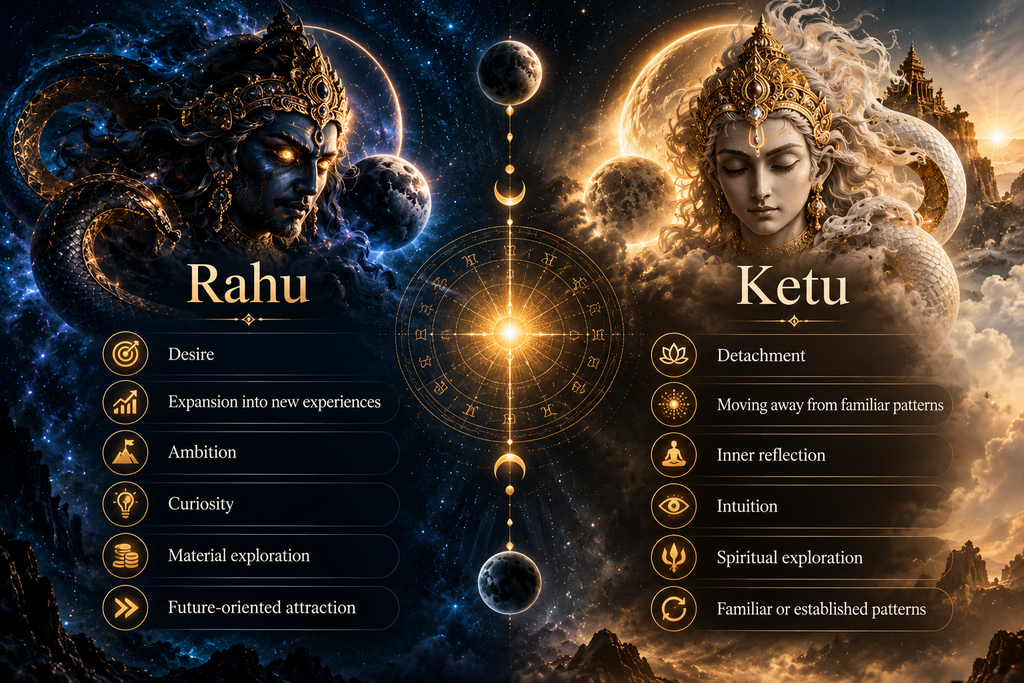
Rahu is traditionally associated with strong desires and the urge to explore experiences outside one’s familiar boundaries.
Its influence may be interpreted through themes such as ambition, experimentation, curiosity and attraction toward things that feel unusual or unfamiliar.
In some charts, Rahu can symbolically represent a strong desire to achieve something that appears difficult or unconventional.
This could manifest as an interest in:
- technology
- foreign cultures
- international opportunities
- entrepreneurship
- unusual career paths
- social recognition
- innovation
- new experiences
However, strong desire can also create restlessness.
A person may achieve one goal and immediately begin searching for another. In traditional astrological interpretation, this is one reason Rahu is often connected with the feeling of “What next?”
How Rahu May Be Interpreted
The interpretation depends heavily on its house, sign, lordship, nakshatra and planetary relationships.
For example, Rahu connected with career-related areas may be interpreted differently from Rahu connected with relationships or education.
Therefore, a responsible astrologer should avoid making a conclusion based on Rahu alone.
Ketu: The Energy of Detachment and Inner Exploration
If Rahu represents intense worldly curiosity, Ketu is traditionally associated with detachment and inward exploration.
Ketu can symbolise areas where a person may feel that they have already experienced something deeply, or where conventional achievement does not provide lasting satisfaction.
This does not necessarily mean that Ketu causes negative events.
Instead, its symbolism is often connected with:
- introspection
- spirituality
- independence
- detachment
- intuition
- research
- self-discovery
- questioning conventional expectations
For some people, Ketu’s influence may correspond with a desire to understand what lies beneath the surface.
This can make Ketu particularly interesting when studying subjects involving spirituality, philosophy, research or personal transformation.
Rahu vs Ketu: What Is the Difference?
The simplest distinction is that Rahu and Ketu operate as opposite points of the same axis.
Think of them as two sides of a developmental journey.
This does not mean that Rahu is bad and Ketu is good.
Both are traditionally considered important for understanding the balance between external experience and internal development.
Rahu and Ketu in Different Houses
One of the most useful ways to understand these nodes is by examining the houses they occupy.
Because Rahu and Ketu are always opposite each other, they create an axis between two areas of life.
1st and 7th House
This axis can bring attention to the relationship between self and partnership.
Questions may include:
- How strongly do I identify with myself?
- How much do I compromise in relationships?
- What do I expect from a partner?
- How do relationships influence my identity?
The complete chart must be considered before making any conclusion.
2nd and 8th House
This combination may bring attention to themes involving:
- family
- finances
- speech
- shared resources
- transformation
- security
It can encourage deeper reflection about personal and shared responsibilities.
3rd and 9th House
This axis may highlight the relationship between:
- personal effort and higher learning
- communication and philosophy
- courage and belief
- short journeys and long-distance experiences
It can be particularly interesting for people who are exploring education, travel or different belief systems.
4th and 10th House
This is traditionally associated with the contrast between home and career.
People with significant activation of this axis may find themselves thinking about questions such as:
Should I prioritise professional achievement or personal stability?
Again, the answer cannot be determined from Rahu and Ketu alone.
5th and 11th House
This axis may involve:
- creativity
- education
- children
- self-expression
- friendships
- networks
- ambitions
- long-term goals
It can raise questions about personal creativity versus collective achievement.
6th and 12th House
This axis can bring attention to themes such as:
- work and service
- health routines
- competition
- expenses
- rest
- isolation
- spirituality
This placement requires particularly careful interpretation because several different life themes can overlap.
How Rahu and Ketu Can Influence Career Questions
Career is one of the most common reasons people seek an astrology consultation.
Rahu is traditionally associated with unconventional ambitions, innovation, foreign connections and a desire to move beyond established boundaries.
For example, someone may feel attracted to:
- technology
- international business
- digital industries
- entrepreneurship
- research
- emerging professions
- unconventional career environments
Ketu, on the other hand, may be interpreted through themes of independence, specialised knowledge, research or reduced attachment to conventional recognition.
But astrology should not be used as the sole basis for an important career decision.
A useful consultation should combine the astrological interpretation with the person’s actual skills, experience, circumstances and goals.
Rahu, Ketu and Relationships
Relationships are another area where the Rahu–Ketu axis can become significant in traditional Vedic astrology.
Rahu may symbolically represent strong attraction, fascination or unusual relationship experiences.
Ketu may represent emotional distance, independence or a need for deeper understanding.
This does not mean that the presence of either node automatically indicates relationship problems.
A proper analysis should consider:
- Venus
- Jupiter
- Moon
- 7th house
- 7th lord
- Navamsa chart
- relevant planetary periods
- Rahu and Ketu
- current transits
This broader approach helps avoid the common mistake of making a major prediction from a single planetary placement.
What Happens During a Rahu or Ketu Transit?
A transit refers to the movement of a planet or astrological point through the zodiac in relation to a person’s natal chart.
When astrologers study Rahu and Ketu transits, they may examine:
- which house the node is moving through
- which natal planets are being influenced
- the relationship between the transit and natal Rahu/Ketu
- current planetary periods
- major life circumstances
This is why a generic statement such as “Rahu is entering your sign, so something bad will happen” does not provide a meaningful interpretation.
Why Birth Time Matters When Studying Rahu and Ketu
Accurate birth details are important in Vedic astrology because the horoscope depends on the date, time and place of birth.
Birth time can influence the calculation of:
- Ascendant
- house positions
- planetary degrees
- divisional charts
- planetary periods
- specific chart relationships
When the birth time is uncertain, an astrologer may need to acknowledge that uncertainty rather than presenting every interpretation as exact.
This is also why a detailed Kundli reading can be more useful than a generic zodiac-sign prediction.
How an Astrologer Interprets Rahu and Ketu
A meaningful consultation generally looks beyond one placement.
An astrologer may consider:
1. House Placement
Where are Rahu and Ketu located?
2. Zodiac Sign
Which sign contains each node?
3. Sign Lord
Which planet rules that sign, and what condition is that planet in?
4. Planetary Associations
Are other planets connected with Rahu or Ketu?
5. Nakshatra
Which lunar mansion contains the node?
6. Dasha
Which planetary period is currently active?
7. Transits
What current planetary movements are relevant?
8. Overall Chart
How does everything fit together?
This is the difference between reading a complete birth chart and simply searching for the meaning of one placement online.
Common Misconceptions About Rahu and Ketu
“Rahu is always negative.”
Not necessarily.
Rahu is traditionally associated with desire, ambition and unconventional experiences. Depending on the chart, these themes can be expressed constructively or become sources of restlessness.
“Ketu always causes loss.”
That is also an oversimplification.
Ketu is traditionally associated with detachment and inward exploration. Detachment can be challenging in some circumstances but valuable in others.
“One Rahu placement determines my entire life.”
A birth chart contains many interconnected factors. One placement cannot provide a complete interpretation.
“Rahu and Ketu only matter during their Mahadasha.”
They can be considered through natal placement, planetary periods, transits and relationships with other chart factors.
Understanding the Rahu–Ketu Axis Through a Simple Example
Imagine someone who has spent years pursuing professional recognition.
They continuously seek a better position, higher income and greater visibility.
From a traditional astrological perspective, a strong Rahu emphasis could be used symbolically to explore this desire for achievement.
But suppose the same person eventually reaches a successful position and still feels dissatisfied.
This may lead to a different question:
“What am I actually trying to achieve?”
This is where the Rahu–Ketu axis becomes interesting.
The purpose of astrology is not necessarily to label a person as lucky or unlucky. It can instead provide a framework for reflecting on patterns, motivations and choices.
Why Choose a Vedic Astrology Consultation in Sydney?
For people living in Sydney, a consultation can be useful when they want a personalised interpretation rather than a general online horoscope.
Someone searching for an astrologer in Sydney may be looking for guidance around:
- career decisions
- relationships
- marriage
- business
- personal development
- birth-chart interpretation
- planetary periods
- Rahu and Ketu
- important life transitions
If you are comparing an Indian astrologer in Sydney, look beyond claims such as “100% accurate predictions.”
Instead, consider whether the practitioner:
- explains the astrological reasoning clearly
- asks for accurate birth information
- provides personalised interpretation
- avoids unnecessary fear
- respects your privacy
- encourages practical decision-making
- has relevant experience
Aunkar Vastu currently describes personalised Vedic astrology and birth-chart consultations for clients in Sydney and across Australia.
How to Choose the Best Astrologer in Sydney
Finding the best astrologer in Sydney is not simply about choosing the person with the biggest claim or the most dramatic prediction.
A better approach is to evaluate the consultation itself.
Ask:
Does the astrologer explain the chart?
You should understand what is being interpreted and why.
Does the astrologer consider your actual situation?
Your questions and circumstances should matter.
Is the advice fear-based?
Be cautious about anyone who pressures you into expensive remedies by creating unnecessary fear.
Is the consultation personalised?
A birth chart is personal. The interpretation should be personal too.
Does the astrologer respect your decisions?
Astrology can offer a perspective, but important decisions remain yours.
Vedic Astrology Guidance Across Australia
At Aunkar Vastu, astrology is presented alongside Vastu Shastra and numerology, with personalised consultation based on individual birth details and circumstances.
The practice identifies Acharya Oum Prakash Sharma as its Vastu, Astrology and Numerology expert and states that he has more than 25 years of experience. Its website also specifically describes consultation services for Sydney and other Australian locations.
For someone looking for Vedic astrology in Sydney, the focus should be on understanding the birth chart rather than receiving a generic prediction.
You can explore the astrology and consultation services offered by Aunkar Vastu through its website.
Frequently Asked Questions
1. What do Rahu and Ketu represent in Vedic astrology?
Rahu and Ketu are traditionally understood as the north and south lunar nodes. Rahu is commonly associated with desire, ambition, experimentation and attraction toward unfamiliar experiences, while Ketu is associated with detachment, introspection, spirituality and letting go. Their interpretation depends on their placement and the rest of the birth chart.
2. Are Rahu and Ketu considered bad planets?
Not necessarily. Rahu and Ketu are often described as challenging influences, but calling them simply “bad” is an oversimplification. Their effects depend on their houses, signs, planetary relationships, nakshatras, dashas and other factors in the horoscope.
3. How do Rahu and Ketu affect a person’s career?
In traditional Vedic astrology, Rahu may be associated with ambition, unconventional professions, technology, foreign connections and strong desires for achievement. Ketu may be associated with specialised knowledge, independence, research or reduced interest in conventional recognition. A complete birth-chart analysis is necessary before drawing conclusions about career.
4. Can Rahu and Ketu affect relationships and marriage?
They can be considered when analysing relationship themes, but they do not independently determine whether a marriage or relationship will succeed. An astrologer may also examine the 7th house, its lord, Venus, Jupiter, Moon, Navamsa chart, planetary periods and relevant transits.
5. How can I find a reliable Indian or Vedic astrologer in Sydney?
Look for an astrologer who provides personalised birth-chart analysis, explains their interpretation clearly, asks for accurate birth details and avoids fear-based claims. If you are comparing the best Indian astrologer in Sydney, consider the quality and transparency of the consultation rather than relying only on promotional claims.