

A Kundli is much more than a page filled with planets, symbols, houses and unfamiliar Sanskrit terms.
In Vedic astrology, a Janam Kundli or birth chart is prepared using details such as your date, time and place of birth. It is then interpreted to understand different patterns connected with personality, relationships, career, finances, family life and important phases of life.
But if you are preparing for your first consultation, it is completely normal to wonder: What should I bring? What will the astrologer actually look at? How long does the process take? And how can I make the consultation more useful?
Whether you are consulting an astrologer in Sydney for the first time or exploring Vedic astrology out of personal interest, understanding the basics beforehand can make the experience much clearer.
At Aunkar Vastu, astrology consultations are approached through traditional Vedic principles with attention to the individual’s circumstances. The practice is led by Acharya Oum Prakash Sharma, who has more than 25 years of experience across Vastu Shastra, Astrology and Numerology.
Here are 10 practical things worth knowing before your first Kundli analysis.
1. Your Birth Details Are the Starting Point
The accuracy of a Kundli begins with the information used to create it.
Typically, three details are especially important:
- Date of birth
- Exact or reasonably accurate time of birth
- Place of birth
The birth time matters because the Ascendant, houses and several other chart calculations can change with time.
For example, two people born on the same day in the same city can have significantly different charts if their birth times are different.
What if you don’t know your exact birth time?
Don’t simply guess if you can avoid it.
Tell the astrologer what you know and explain whether the time comes from a birth certificate, hospital record, family memory or another source. Depending on the situation, an astrologer may discuss birth-time rectification or work with the information available.
The important thing is transparency.
2. A Kundli Is Not the Same as a Daily Horoscope
One of the easiest ways to misunderstand astrology is to treat a birth chart like a newspaper horoscope.
A daily horoscope generally works with broad zodiac-based information.
A Kundli is individual.
It maps planetary positions associated with your specific birth details and provides a framework for a more personalised interpretation.
This is one reason a proper consultation can involve considerably more discussion than simply asking, “What is my zodiac sign?”
A professional reading may examine several connected parts of the chart rather than making a conclusion from one planetary position.
3. Learn the Basic Parts of Your Kundli
You don’t need to become an astrology expert before your consultation.
However, knowing a few basic terms can make the conversation easier.
| Kundli Element | What It Generally Represents |
| Lagna / Ascendant | The sign rising at the time of birth and an important starting point for chart interpretation |
| Moon Sign | Often examined in relation to emotions, mental tendencies and inner responses |
| Houses / Bhavas | Different areas of life examined through the chart |
| Planets / Grahas | Planetary influences interpreted according to their positions and relationships |
| Nakshatras | Lunar constellations used extensively in Vedic astrology |
| Dasha | Planetary periods used by Vedic astrologers to examine timing |
| Navamsa / D-9 | An important divisional chart used for deeper analysis |
You don’t have to memorise all of these.
The goal is simply to understand what your astrologer is referring to during the session.
4. The 12 Houses Give the Reading Its Life Context
The houses of a Kundli are important because they connect planetary placements with different areas of life.
A simplified overview looks like this:
| House | Common Area of Interpretation |
| 1st | Self, personality, identity |
| 2nd | Family, speech, accumulated resources |
| 3rd | Communication, courage, siblings |
| 4th | Home, comfort, mother, emotional foundations |
| 5th | Creativity, education, children, intelligence |
| 6th | Work, service, competition, challenges |
| 7th | Marriage, partnerships, relationships |
| 8th | Transformation, shared resources, deeper matters |
| 9th | Beliefs, higher learning, fortune, long-distance journeys |
| 10th | Career, profession, reputation |
| 11th | Gains, networks, aspirations |
| 12th | Expenses, retreat, foreign connections, isolation |
This is only a basic framework.
A proper interpretation doesn’t mean looking at one house and immediately making a prediction. The wider chart, planetary placements, aspects, strength and timing techniques may all be considered together.
5. Timing Is Often as Important as the Placement
A common question during a Kundli consultation is:
“What is going to happen?”
A more useful question can sometimes be:
“When might this particular area become more significant?”
Vedic astrology uses different timing techniques, including Dasha systems and planetary transits, to examine periods of change or emphasis.
For example, someone may want to understand when career responsibilities could become a stronger focus, or when relationship matters may deserve greater attention.
This is also why a good consultation shouldn’t necessarily be reduced to one fixed prediction.
The chart can be discussed in terms of patterns, possibilities, timing and practical choices rather than treating the future as something that cannot change.
6. Know What You Actually Want to Ask
A first consultation can become overwhelming if you arrive with twenty unrelated questions.
Before your appointment, write down the two or three areas that matter most to you.
For example:
- Career direction
- Business decisions
- Marriage or relationship compatibility
- Family concerns
- Education
- Relocation
- Financial planning
- Personal development
- Important upcoming periods
This doesn’t mean other aspects of your chart cannot be discussed.
It simply gives the consultation a clearer direction.
Why does this help?
Because astrology consultations are most useful when the discussion connects the chart with a real question you are trying to understand.
7. Ask How the Interpretation Was Reached
You should never feel uncomfortable asking your astrologer to explain their reasoning.
If the consultation highlights a particular planetary combination, ask:
“What in the chart indicates this?”
If a timing period is discussed, ask:
“Which planetary period or transit are you referring to?”
If a remedy is suggested, ask:
“What is the purpose of this remedy?”
These questions encourage a more transparent conversation.
At Aunkar Vastu, the organisation describes its astrology approach as combining traditional Vedic astrology with personalised interpretation and practical guidance.
8. Be Careful With Absolute Predictions
A responsible consultation should leave room for interpretation and personal choice.
Be cautious about anyone who presents every aspect of your future as completely predetermined or guarantees a specific outcome.
Astrology is traditionally used by practitioners as a framework for interpreting planetary patterns and timing. It should not replace professional advice in areas such as medical care, legal matters or financial decisions.
Instead, use the consultation as an opportunity for reflection and perspective.
The best question is often not:
“Can you guarantee what will happen?”
but:
“What does the chart suggest, and how can I approach this period thoughtfully?”
9. Ask About Remedies With Context
Depending on the tradition and the astrologer’s approach, a consultation may include recommendations such as mantras, charitable practices, lifestyle adjustments, spiritual practices or other remedies.
Don’t follow a remedy simply because someone says it is “powerful.”
Understand its purpose first.
Ask:
- Why has this been recommended?
- Which part of the chart is it connected to?
- How should it be practised?
- For how long?
- Is there a simpler alternative?
A good consultation should leave you understanding why something has been suggested rather than feeling pressured into it.
10. Choose the Right Astrologer for the Way You Want to Be Guided
Not every consultation feels the same.
Some people want a highly traditional interpretation. Others prefer a conversational approach that connects classical astrology with modern life.
Before booking, consider:
- Experience and background
- The type of astrology being practised
- Whether consultations are personalised
- Whether the astrologer explains the reasoning behind interpretations
- Whether your questions are welcomed
- Whether the consultation feels practical and respectful
- Whether the astrologer clearly communicates limitations
For people searching for the best Indian astrologer in Sydney, the phrase “best” should not simply mean the person with the strongest marketing claims.
Look for demonstrated experience, clarity, relevant expertise and an approach that makes sense for your needs.
A Simple Kundli Consultation Checklist
Before your appointment, keep this checklist handy:
- Confirm your date of birth.
- Confirm your birth time as accurately as possible.
- Note your birthplace.
- Write down your top three questions.
- Decide which area of life you want to focus on.
- Bring any relevant previous astrology information if you have it.
- Be open about uncertainty in your birth details.
- Ask questions when something is unclear.
- Understand the reasoning behind recommendations.
- Treat the consultation as guidance rather than a substitute for professional advice.
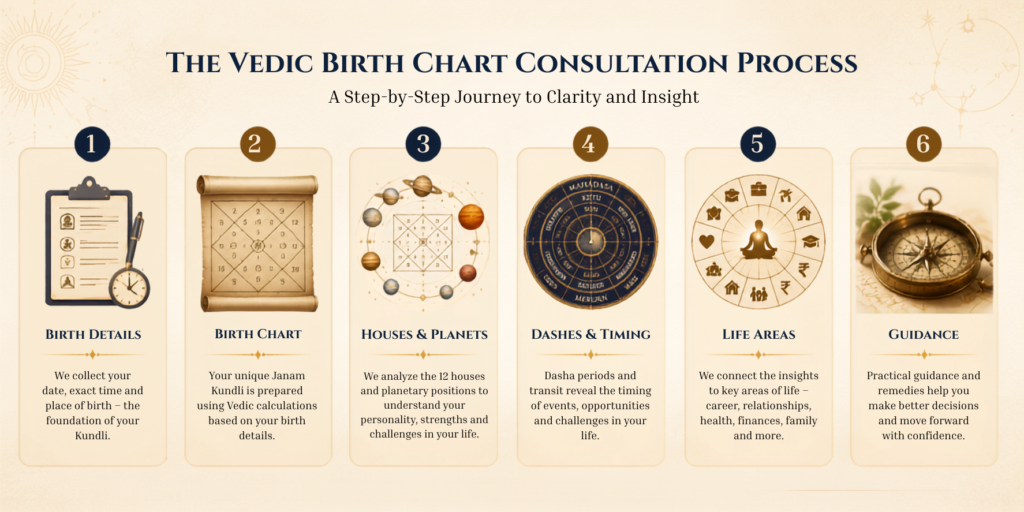
A Quick Visual Guide: What Happens During a Kundli Analysis?
Think of a consultation as a sequence rather than a single prediction:
Should You Consult an Astrologer in Sydney Online or In Person?
Location doesn’t necessarily determine the quality of an astrology consultation.
If you live in Sydney, you may prefer a local consultation because it can be convenient and easier to schedule. Online consultations can also be useful for people who prefer speaking from home or have limited availability.
The more important consideration is whether the consultation is personalised and whether your birth information can be reviewed properly.
Aunkar Vastu provides astrology guidance for clients in Sydney and across Australia, with its best astrologer in Sydney service focused on personalised Vedic astrology consultations.
Frequently Asked Questions
1. What should I bring to my first Kundli consultation?
You should have your date of birth, birth time and birthplace available. If your birth time comes from an official record, keep that information handy. You can also prepare a short list of the life areas or questions you want to discuss.
2. How important is birth time in Kundli analysis?
Birth time can be important because the Ascendant and house positions depend on the time of birth. Even a relatively small difference can matter in some chart calculations. If you aren’t certain about your birth time, tell the astrologer rather than guessing.
3. Can a Kundli tell me exactly what will happen in the future?
A Kundli is traditionally interpreted to understand planetary patterns and periods rather than as a guarantee of exact future events. A thoughtful consultation should discuss possibilities and timing while recognising that individual decisions and circumstances also matter.
4. Why are the 12 houses important in a Kundli?
The 12 houses provide a framework for examining different areas of life, including personality, family, relationships, career, gains and other experiences. Their interpretation depends on the wider chart rather than on the house alone.
5. How do I choose an astrologer in Sydney for a Kundli consultation?
Look beyond claims such as “best” or “top.” Consider the practitioner’s experience, approach, transparency, ability to explain the reading and whether the consultation is tailored to your questions. You should feel comfortable asking how conclusions and recommendations were reached.